Species Sightings
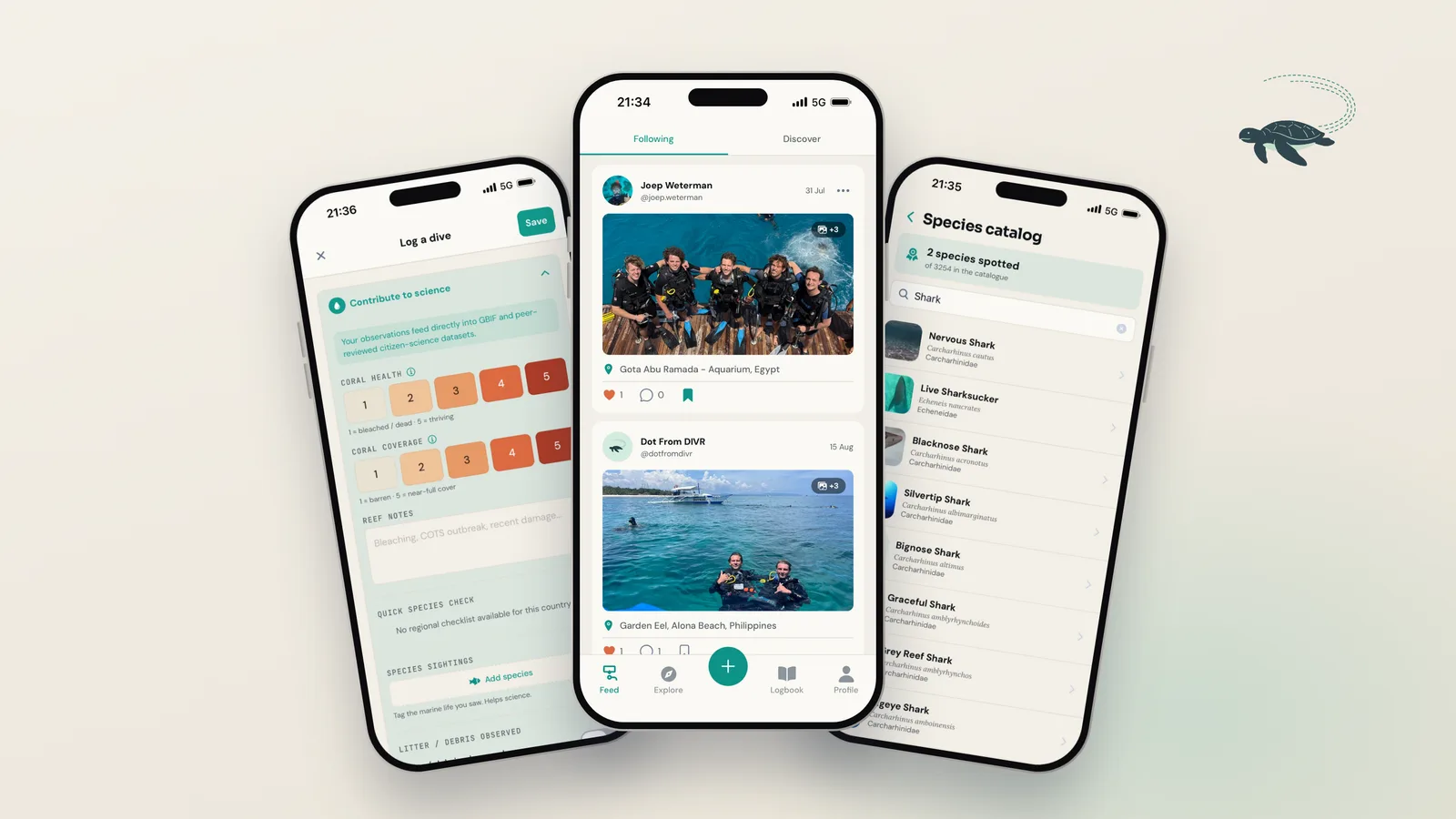
Search and tag marine species from a database of 4,556 WoRMS-verified species, each linked to the global taxonomic backbone. Build a living record of what lives at every dive site.
Every recreational diver is already observing the ocean. DIVR turns those observations into valuable scientific data. No extra effort, no separate apps, no training required.
83%
of divers want to help with ocean conservation but struggle to find ways to do so
Reef-World / PADI Sustainability Survey, 2022
85%
of divers agree marine citizen science benefits society, environment, and science
Lucrezi et al., PLOS ONE, 2018
17%
of divers have actually participated in citizen science. Massive untapped potential
Lucrezi et al., PLOS ONE, 2018
DIVR bridges that gap.
Search and tag marine species from a database of 4,556 WoRMS-verified species, each linked to the global taxonomic backbone. Build a living record of what lives at every dive site.
Rate reef health on a simple five-step scale during every dive. Track changes over time and help identify reefs in decline.
Log water temperature, visibility, and current strength. These data points help researchers monitor ocean conditions at scale.
All of this happens inside your normal dive log. Zero extra effort, zero separate apps. Just log your dive as usual.
Community science is built right into your dive log. No separate forms, no extra steps. Just dive, log, and contribute.
Scientists need to trust the data before they can use it. That's why every observation on DIVR passes through a multi-stage quality pipeline before it reaches research databases.
01
Was this species reported at a depth and location where it actually lives? We cross-check every sighting against known species ranges from scientific databases.
02
When multiple divers independently report the same species at the same site around the same time, that's strong evidence. We cluster observations to find these natural confirmations.
03
Each observation carries a confidence score rather than a silent pass or fail. Photo-based cross-checks join this stage as the models below come online.
04
Over time, we learn how reliable each diver's identifications are. An experienced diver's report carries more weight, earned through consistent, accurate observations.
05
Divers tend to visit popular, accessible sites. We statistically adjust for this so that species counts reflect actual biodiversity, not just where people dive most.
The result: every observation gets a quality score that researchers can use to set their own standards for what to include.
Two computer vision models are the main thing DIVR is building over the next year. Both exist for the same reason: to make what a diver sees measurable instead of anecdotal. Both need real dives to get there, which is why the pilots matter more than the code.
Reads coral cover and bleaching straight from the scenery photos divers already take, as percentages rather than impressions. The hard part is not reading the photo, it is proving the reading is right, so every result is calibrated against the coral health ratings divers give by hand.
Where it stands: early. A coral score a park manager should act on is quarters away, not weeks. Pilot dives with marine parks this autumn produce the paired photos and ratings that shorten it.
Suggests candidate species from a dive photo and checks them against the same WoRMS-backed catalog the app already uses, so a diver picks from a shortlist instead of scrolling thousands of names.
Where it stands: in development. Species logging works today by search, without any model. Identification support is an assist on top of the diver's judgement, never a replacement for it.
DIVR is an official EMODnet Associated Partner, recognised by the EMODnet Steering Committee in September 2026. Our export pipeline is built and has been reviewed by the EMODnet Biology team at VLIZ. Once divers begin logging, those anonymized observations are expected to be published in EMODnet Biology and also flow to OBIS and GBIF, the databases scientists around the world rely on. Your dives help fill gaps in our understanding of ocean health.
European Marine Observation and Data Network, the EU's open marine data platform
Ocean Biodiversity Information System, the global hub for marine species data
Global Biodiversity Information Facility, over 2 billion occurrence records worldwide
All data is fully anonymized before sharing. Your identity is never included
Before any data is shared, it passes through our 5-stage quality pipeline and is fully anonymized. Read more in our Terms of Service.